
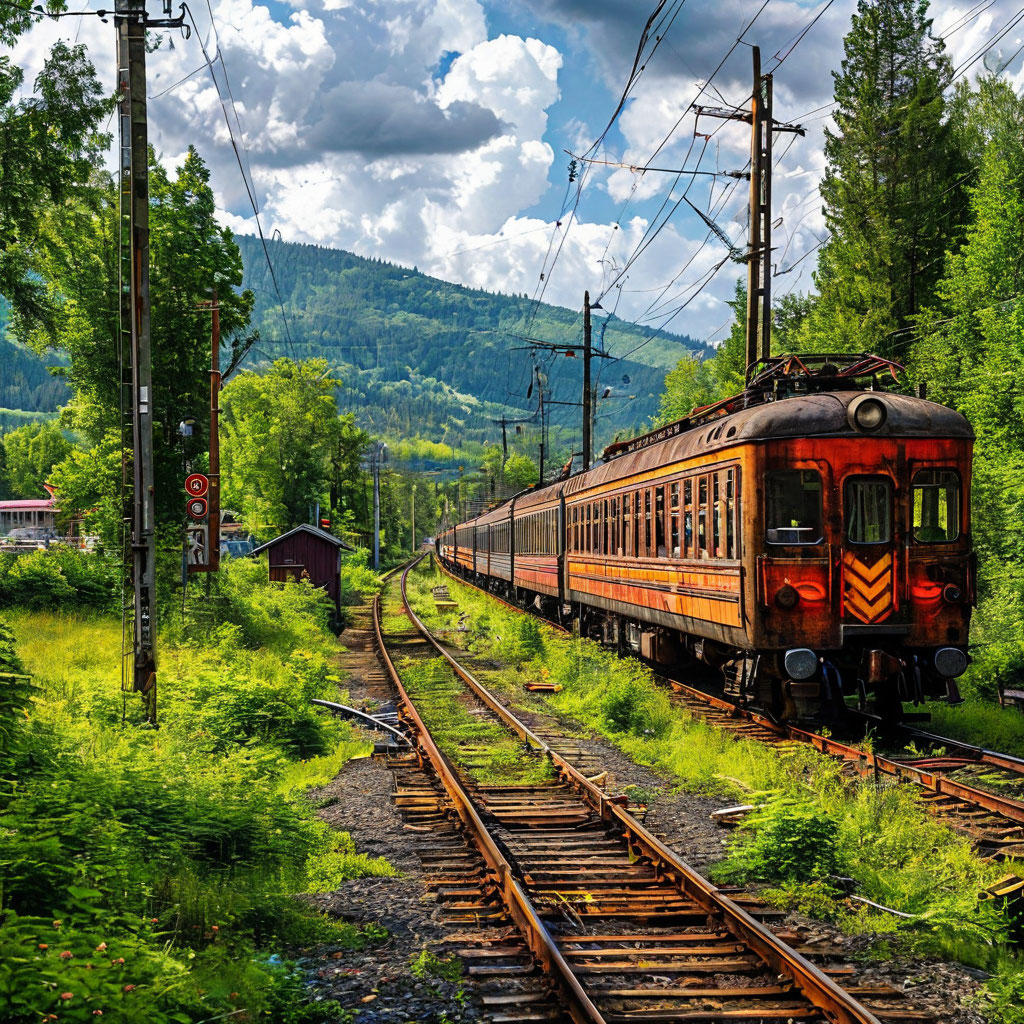
The Iron Backbone: Tracing the Evolution of Railway Infrastructure in the Urals
Imagine standing at the foot of the Ural Mountains, the vast expanse of Russia’s natural frontier stretching before you. Now, picture the rhythmic chug of a steam locomotive cutting through this rugged terrain, connecting distant cities and transforming the landscape. This was the reality in the 19th century, as the Ural region underwent a railway revolution that would reshape its economic and social fabric.
The Dawn of Russian Railways
The journey of railways in Russia began in the early 19th century, with the Cherepanov family leading the charge. In 1834, Yefim and Miron Cherepanov, serfs working for the Demidov family, crafted the first Russian steam locomotive. This pioneering engine traversed a modest two-kilometer track from a factory in Nizhny Tagil to a nearby mine, marking the inception of steam-powered transport in Russia. Their innovation laid the groundwork for future railway developments, even though it would take several more years for railways to become a significant part of Russia’s transportation network. ([en.wikipedia.org](https://en.wikipedia.org/wiki/Cherepanov_steam_locomotive?utm_source=openai))
Connecting the Empire: The Tsarskoye Selo Railway
In 1837, Russia’s first public railway, the Tsarskoye Selo Railway, opened between Saint Petersburg and Tsarskoye Selo. Initially intended for leisure, this 27-kilometer line set the stage for more extensive railway projects. The success of this venture demonstrated the potential of rail transport, leading to the construction of the Moscow-Saint Petersburg Railway, which opened in 1851, further solidifying the role of railways in Russia’s development. ([en.wikipedia.org](https://en.wikipedia.org/wiki/Tsarskoye_Selo_Railway?utm_source=openai), [en.wikipedia.org](https://en.wikipedia.org/wiki/Saint_Petersburg%E2%80%93Moscow_railway?utm_source=openai))
Bridging the Divide: The Samara-Ufa Railway
As Russia’s industrial ambitions grew, so did the need for efficient transportation networks. The completion of the Samara-Ufa Railway in 1888 was a pivotal moment for the Ural region. This line connected Ufa directly to Moscow, traversing the challenging Ural Mountains. The construction was no small feat, with rocky soils and sparse populations posing significant obstacles. Yet, the railway’s completion spurred rapid industrialization in the area. Ufa’s population nearly doubled by 1897, and the number of factories employing more than sixteen workers almost doubled in the 1890s. This surge in industrial activity transformed Ufa into a burgeoning urban center, complete with improved infrastructure and a burgeoning workforce. ([scalar.fas.harvard.edu](https://scalar.fas.harvard.edu/imperiia/construction-of-the-samara-ufa-railway-and-industrialization-1888-1900?utm_source=openai))
The Ural Railway Network: A Web of Connectivity
The late 19th century witnessed the expansion of the Ural railway network, connecting key cities and facilitating economic growth. The Perm–Yekaterinburg line, opened in 1879, and the Yekaterinburg–Tyumen line, completed in 1885, were instrumental in linking the Ural region with Siberia. These lines not only bolstered trade but also integrated the Ural’s rich mineral resources into the broader Russian economy. Yekaterinburg, in particular, emerged as a central hub, with seven main railway lines converging in the city, underscoring its strategic importance. ([en.wikipedia.org](https://en.wikipedia.org/wiki/Sverdlovsk_Railway?utm_source=openai), [en.wikipedia.org](https://en.wikipedia.org/wiki/Yekaterinburg?utm_source=openai))
Legacy of the Iron Tracks
The 19th-century railway developments in the Urals were more than just engineering feats; they were catalysts for profound change. They bridged vast distances, fostered economic growth, and knit together a diverse empire. The iron tracks that once traversed the Ural Mountains now stand as monuments to human ingenuity and ambition, echoing the transformative power of connectivity and progress.
As you reflect on this journey through time, consider how these railways not only connected cities but also hearts and minds, weaving a tapestry of shared experiences and aspirations across the vast expanse of Russia.
