
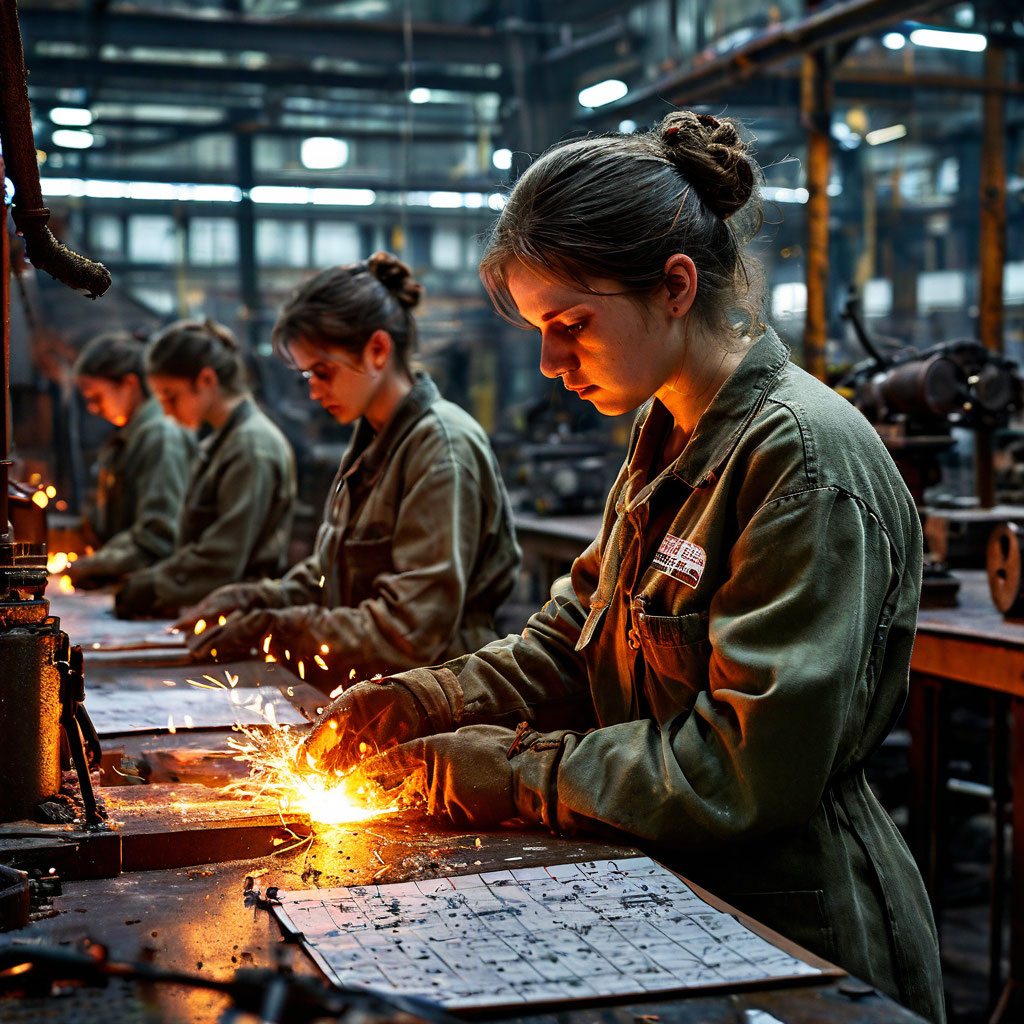
The Role of Women in Ural’s Industrial Workforce during WWII
Imagine a time when the world was engulfed in the chaos of World War II. Amidst the turmoil, the Ural region of Russia stood as a beacon of resilience and industrial might. But behind the roaring factories and bustling assembly lines was an often-overlooked force: the women who stepped into roles traditionally held by men, ensuring the Soviet Union’s war machine kept running. Their stories are not just tales of survival but of empowerment, determination, and an unyielding spirit.
The Call to Arms: Mobilizing the Female Workforce
As the war intensified, the Soviet Union faced a dire shortage of male workers due to conscription. The Ural region, with its vast industrial base, was pivotal in the nation’s defense strategy. To meet the escalating demands, a significant shift occurred: women were called upon to fill the void left by men. This wasn’t merely a matter of necessity; it was a testament to the Soviet leadership’s belief in the capability and resilience of its female citizens.
In 1944, women constituted over half of the workforce in sectors like light and food industries. Specifically, they made up 64% in meat and dairy, 46.2% in the fishing industry, and an astounding 90% in light and textile industries. Their contributions were not just in numbers but in the quality and efficiency they brought to their roles. Many women initiated movements within industries to expedite orders for the front, conserve raw materials, and optimize labor resources. Their proactive approach ensured that the production lines never faltered, even under the most challenging circumstances. ([archive.lenobl.ru](https://archive.lenobl.ru/ru/dokumenty/80-letiyu-nachala-velikoj-otechestvennoj-vojny-1941-1945-gg-posvyashae/cikl-statej-na-temu-idyot-vojna-narodnaya-svyashennaya-vojna/?utm_source=openai))
Breaking Barriers: Women in Heavy Industry
The Ural region was renowned for its heavy industries, including steel production, machinery, and defense manufacturing. Traditionally, these sectors were male-dominated, with women seldom seen in such roles. However, the exigencies of war necessitated a radical transformation. Women not only entered these industries but excelled in them, often surpassing expectations.
At the Magnitogorsk Iron and Steel Works (MMK), a pivotal enterprise in the Ural industrial landscape, women took on roles that were previously unthinkable. In October 1941, female brigades were established in the blast furnaces. Workers like M. I. Manakhina, N. A. Karnaukova, E. I. Ilyina, and N. A. Spirina consistently exceeded production norms, achieving 200% of their targets. Their work was so exemplary that steel ladles, which typically lasted for 4-5 melts, now endured 10-11 melts. This remarkable efficiency not only boosted production but also set new standards for quality and durability. ([ru.wikipedia.org](https://ru.wikipedia.org/wiki/%D0%9C%D0%B0%D0%B3%D0%BD%D0%B8%D1%82%D0%BE%D0%B3%D0%BE%D1%80%D1%81%D0%BA?utm_source=openai))
From Homemakers to Heavyweights: The Transformation
Many of these women began as homemakers, with little to no prior industrial experience. The transition was neither easy nor immediate. It required intensive training, adaptability, and an unwavering commitment to the cause. The Soviet government recognized this and implemented accelerated training programs, workshops, and on-the-job learning sessions. Women were not just filling in; they were mastering complex machinery, understanding intricate processes, and contributing to innovations that enhanced productivity.
For instance, at the Sverdlovsk Machine-Building Plant, women made up 34.1% of the workforce, with over 50% in the heavy casting department. Their presence was not just a statistical anomaly but a driving force behind the plant’s success in producing heavy weaponry. Their ability to adapt and excel in these roles was a testament to their resilience and determination. ([a-z.ru](https://a-z.ru/women/texts/murman1r-1.htm?utm_source=openai))
Beyond the Factory: Women in Agriculture and Transportation
The industrial sector was not the only arena where women made their mark. With a significant portion of the male population enlisted in the military, women stepped into roles in agriculture and transportation, sectors vital to the nation’s sustenance and mobility.
In agriculture, women constituted 75% of the workforce between 1941 and 1945. They operated tractors, combined harvesters, and managed livestock. In 1943, women made up 62% of combine operators and 56% of tractor drivers. Their expertise ensured that the Soviet Union remained self-sufficient, feeding both its military and civilian populations. ([archive.lenobl.ru](https://archive.lenobl.ru/ru/dokumenty/80-letiyu-nachala-velikoj-otechestvennoj-vojny-1941-1945-gg-posvyashae/cikl-statej-na-temu-idyot-vojna-narodnaya-svyashennaya-vojna/?utm_source=openai))
On the railways, women took on roles as conductors, station managers, and maintenance workers. By the end of 1942, over 35,000 women were employed in the railway sector, a significant increase from previous years. Their efficiency and dedication kept the supply lines open, ensuring that troops and resources moved seamlessly across the vast expanse of the Soviet Union. ([history.wikireading.ru](https://history.wikireading.ru/273695?utm_source=openai))
Recognition and Legacy: Honoring the Unsung Heroes
Despite their monumental contributions, many of these women remained unsung heroes for decades. However, their impact was undeniable. Over 250,000 women were awarded orders and medals for their selfless labor and bravery. More than 130 women became laureates of the State Prizes of the USSR, with many honored as Heroes of Socialist Labor. Their stories, once overshadowed by the male-dominated narratives of war, are now being recognized and celebrated. ([archive.lenobl.ru](https://archive.lenobl.ru/ru/dokumenty/80-letiyu-nachala-velikoj-otechestvennoj-vojny-1941-1945-gg-posvyashae/cikl-statej-na-temu-idyot-vojna-narodnaya-svyashennaya-vojna/?utm_source=openai))
The legacy of these women is multifaceted. They not only contributed to the Soviet Union’s victory but also paved the way for future generations of women in the workforce. Their stories challenge traditional gender roles and highlight the potential of women when given the opportunity and support. The Ural region, with its rich industrial heritage, stands as a testament to their resilience and determination.
Conclusion: A Testament to Resilience and Empowerment
The role of women in the Ural’s industrial workforce during World War II is a powerful narrative of transformation, resilience, and empowerment. These women, many of whom were thrust into unfamiliar and challenging roles, not only adapted but excelled, ensuring the Soviet Union’s industrial prowess remained unchallenged. Their stories are a testament to the indomitable human spirit and the capacity to rise above adversity. As we reflect on their contributions, we are reminded of the importance of recognizing and honoring the unsung heroes who shape our history.
