Kachkanar Monastery Peak: From Iron Ore Survey to Mining Town
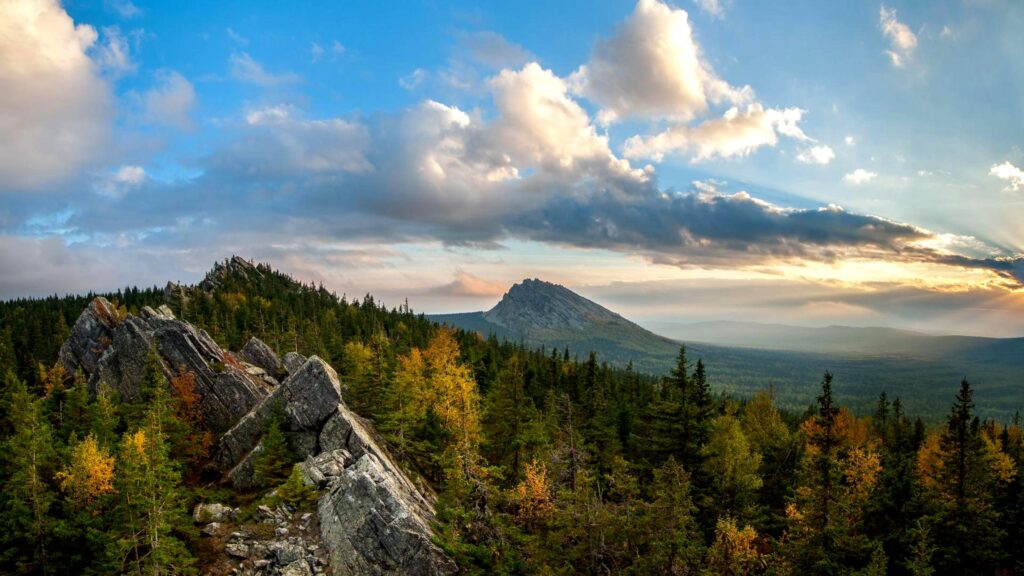
Imagine standing at the foot of a towering mountain, its summit piercing the sky at 878.7 meters. This is Kachkanar, the highest peak of the Central Ural Mountains in Russia’s Sverdlovsk Oblast. Its imposing presence has been a silent witness to centuries of exploration, conflict, and transformation. Let’s embark on a journey through time to uncover the story of Kachkanar—from its initial survey for iron ore to its evolution into a bustling mining town.
The Early Years: A Mountain of Mysteries
Our tale begins in the 18th century. Picture the year 1770, when the renowned academician Peter Simon Pallas traversed the Ural Mountains. During his expedition, he encountered Kachkanar, then known as “Kushanar.” Pallas was captivated by the mountain’s unique magnetic properties; compass needles would deflect wildly in its vicinity. This anomaly piqued the interest of geologists and miners alike, hinting at the rich mineral deposits hidden within.
Fast forward to 1789, and another explorer, Benedict Franz Johann von Herrmann, documented his journey through the Urals. He noted that the western side of Kachkanar was rich in ore containing 59% iron, with veins of magnetic ironstone visible on the surface. Despite these promising signs, the mountain’s dense and refractory ores posed challenges for mining, leading to a decline in interest over time.
The Platinum Rush and the Rise of Kachkanar
The 19th century brought a new wave of excitement to the region. Nearby, the Is River yielded rich platinum and gold placers, attracting prospectors from far and wide. Amidst this fervor, Kachkanar’s magnetic iron ore found a niche. Miners utilized it to separate ferruginous concentrates when washing the rock, a testament to the mountain’s subtle yet significant role in the mining industry.
In 1849, British geologist Roderick Impey Murchison marveled at Kachkanar’s rugged beauty. He likened its wild, rocky nature to the highlands of Scotland and the Alps, underscoring the mountain’s unique geological significance. Yet, despite its allure, the mountain’s ores remained underutilized due to their challenging extraction process.
The Soviet Era: From Exploration to Industrialization
The early 20th century marked a turning point. Soviet geologists, recognizing the untapped potential of Kachkanar’s ores, initiated systematic exploration. In the 1930s, under the leadership of I.I. Malyshev and P.G. Panteleev, detailed studies of the Kachkanar group of iron ore deposits began. Their efforts laid the groundwork for what would become a significant industrial endeavor.
By the 1950s, the Soviet Union’s industrial ambitions led to the establishment of the Kachkanar Mining and Processing Plant (GOK). In 1957, construction began near the mountain’s foot, and the following year, the project was declared an All-Union Komsomol shock construction project. This initiative aimed to harness the rich titanomagnetite ores of the region, which also contained vanadium—a valuable element for steel and cast iron alloys.
As the plant took shape, so did the town of Kachkanar. Founded in 1958, it quickly grew into a bustling industrial hub. By 1968, it was granted city status, becoming the youngest city in Sverdlovsk Oblast. The town’s rapid growth mirrored the success of the mining operations, with the population increasing more than tenfold between 1959 and 1983. This surge transformed Kachkanar into a vibrant community centered around the mining industry.
The Monastery on the Mountain: A Spiritual Sanctuary
Amidst the industrial landscape, a unique spiritual community found its home on Kachkanar. In 1995, Lama Tingdzin Dokshit, a Russian Buddhist monk, established the Shedrub Ling Monastery on the mountain’s northeastern slope. The name, translating to “Place of Practice and Realization,” reflected the community’s mission to create a sanctuary for meditation and spiritual growth.
The monastery’s construction was a labor of love. Lama Tingdzin Dokshit, originally from the Perm Agricultural Institute, had studied Buddhism in Buryatia. Inspired by his experiences, he chose Kachkanar for its serene environment and spiritual significance. Over time, the monastery expanded to include stupas, a temple hall, living quarters, and even a tea house, all harmoniously integrated into the mountain’s rocky terrain.
The peaceful coexistence between the monastery and the mining operations was not to last. In 2006, the Kachkanar Mining and Processing Plant received a license to develop the Sobstvenno-Kachkanarskoye deposit, which encompassed the very area where the monastery stood. The court declared the monastery’s buildings illegal and ordered their demolition, citing the need for mining expansion.
Despite the legal challenges, the Buddhist community remained steadfast. Negotiations ensued, and in 2019, an agreement was reached to relocate the monastery to the village of Kosya, at the foot of the mountain. The new arrangement allowed the community to maintain access to the mountain’s summit, preserving their spiritual practices while accommodating the mining operations.
By 2022, the monastery’s buildings were dismantled by the mining company, but the religious structures were preserved. This resolution marked a new chapter in the relationship between industry and spirituality on Kachkanar, highlighting the complexities of balancing economic development with cultural and religious heritage.
Today, Kachkanar stands as a testament to the dynamic interplay between nature, industry, and culture. The mountain’s rich mineral resources continue to fuel the mining operations, contributing significantly to the region’s economy. The town of Kachkanar thrives, its skyline a blend of Soviet-era architecture and modern developments.
The legacy of the Shedrub Ling Monastery endures, albeit in a new form. The community’s relocation to Kosya has allowed them to continue their spiritual practices, ensuring that the mountain’s sacred significance remains intact. The preserved religious structures on Kachkanar serve as a reminder of the enduring human spirit and the quest for harmony between progress and tradition.
As you stand at the foot of Kachkanar today, you are not merely gazing at a mountain. You are looking at a living chronicle of human endeavor—a place where exploration, industry, and spirituality have intersected, each leaving an indelible mark on the landscape. Kachkanar’s story is a vivid tapestry woven from the threads of ambition, faith, and resilience, inviting us to reflect on the complex narratives that shape our world.
