
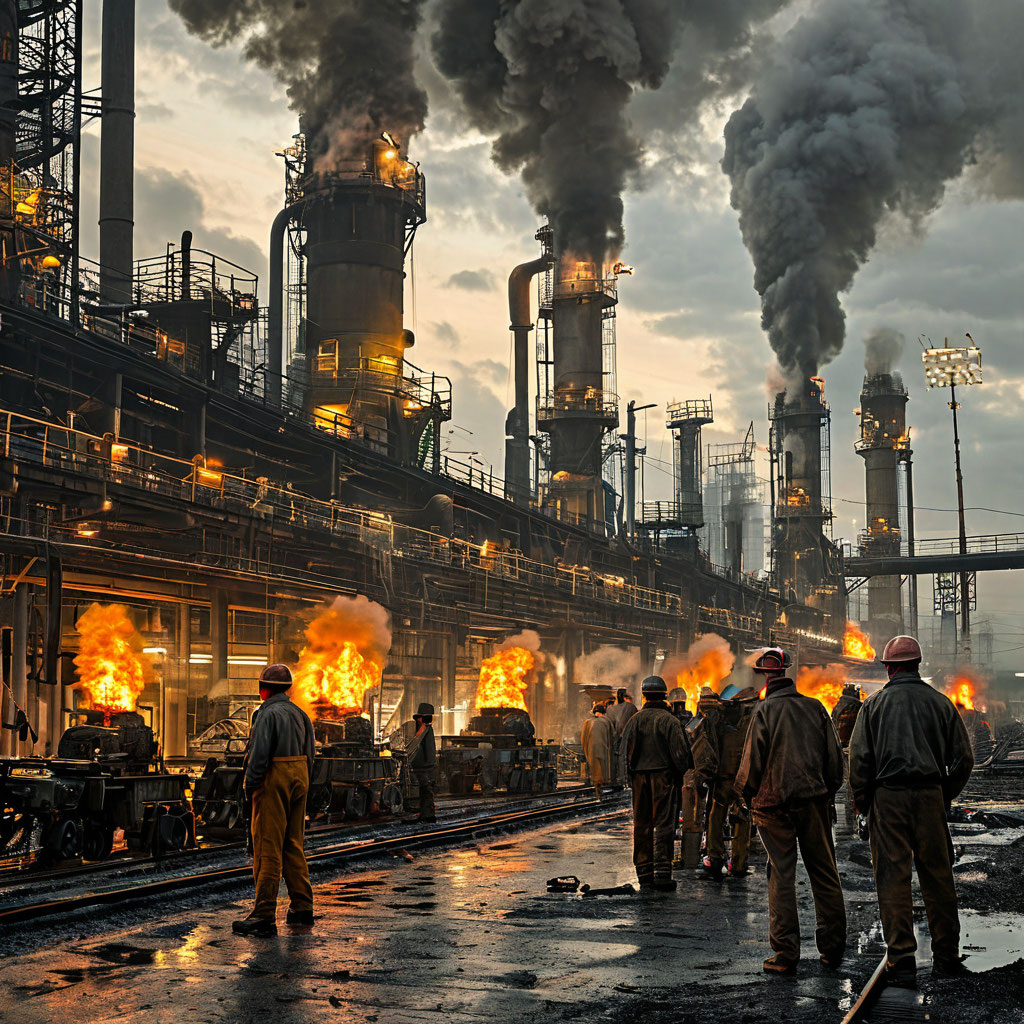
The Evolution of Ural’s Metallurgical Industry in the 20th Century
Imagine a vast expanse of mountains and forests, rich in minerals and history. This is the Ural region, a land that has been the heartbeat of Russia’s metallurgical industry for centuries. In the 20th century, the Ural’s metallurgical industry underwent remarkable transformations, shaping not only the region but also the entire nation. Let’s embark on a journey through time to explore how this industry evolved, faced challenges, and emerged as a cornerstone of Russia’s industrial prowess.
The Early 20th Century: A Period of Transformation
At the dawn of the 20th century, Russia’s metallurgical industry was grappling with significant challenges. The Ural region, once a thriving center of metal production, was experiencing a decline. In 1909, Ural’s blast furnaces produced 34.7 million tons of pig iron, a 30.9% decrease from 1900 levels. This downturn was attributed to outdated equipment, competition from southern Russia’s factories, and a global economic crisis. However, the Ural’s metallurgical industry was resilient. To combat these challenges, factories began modernizing their equipment, introducing new technologies, and seeking new markets. This period laid the foundation for the industry’s resurgence in the coming decades. [Source: История металлургии Урала]
The Soviet Era: Rebuilding and Expansion
The aftermath of the Russian Civil War left the Ural’s metallurgical industry in ruins. By 1921, only 20% of the pre-war factories were operational, producing a mere 10% of the previous output. The industry faced severe shortages of raw materials, skilled labor, and modern equipment. However, the Soviet government recognized the strategic importance of the Ural’s metallurgical sector and embarked on an ambitious plan to rebuild and expand it. The establishment of the Ural Industrial Bureau in 1919 marked the beginning of this transformation. The government annulled the debts of enterprises, provided free raw materials, and centralized the management of factories. By the end of 1919, the Ural’s factories boasted 14 blast furnaces, 16 open-hearth furnaces, and 49 rolling mills. This period also saw the development of the “Three-Year Program for the Development of the Metallurgical Industry in the Urals,” which laid the groundwork for future growth. [Source: История металлургии Урала]
The Great Patriotic War: The Ural’s Industrial Backbone
As World War II erupted, the Ural’s metallurgical industry became a linchpin in the Soviet Union’s war effort. With much of the European part of the USSR occupied, the Ural factories were relocated eastward, and their production capacity was expanded. By 1941, the Ural’s factories produced about 66% of the Soviet Union’s pig iron, over 50% of its steel, and 60% of its aluminum. The Ural’s metallurgical plants were instrumental in producing tanks, artillery, and ammunition, contributing significantly to the Soviet victory. [Source: История металлургии Урала]
The Post-War Era: Reconstruction and Innovation
After the war, the Ural’s metallurgical industry faced the daunting task of reconstruction. The factories had suffered from years of neglect and required modernization. The government invested heavily in rebuilding efforts, leading to the establishment of new plants and the expansion of existing ones. The 1950s and 1960s witnessed the construction of significant facilities, including the Magnitogorsk Metallurgical Combine, the Chelyabinsk Metallurgical Plant, and the Sverdlovsk Metallurgical Plant. These plants became symbols of Soviet industrial might and were crucial in meeting the nation’s growing demand for metals. [Source: История металлургии Урала]
Technological Advancements and Global Recognition
The mid-20th century was a period of technological innovation for the Ural’s metallurgical industry. The introduction of new technologies, such as continuous casting and electric arc furnaces, improved efficiency and product quality. The Ural’s factories began producing a wider range of products, including high-strength steels and non-ferrous metals. The region’s metallurgical products gained international recognition for their quality and reliability, solidifying the Ural’s reputation as a global industrial hub. [Source: История металлургии Урала]
The Late 20th Century: Challenges and Adaptation
The 1970s and 1980s presented new challenges for the Ural’s metallurgical industry. The global economy underwent significant changes, and the Soviet Union faced economic stagnation. The Ural’s factories, many of which were built in the mid-20th century, began to show signs of aging. The industry faced environmental concerns, labor shortages, and the need for further modernization. In response, the government initiated programs to upgrade equipment, improve labor conditions, and address environmental issues. Despite these efforts, the industry faced a period of stagnation, and the Ural’s metallurgical sector had to adapt to the changing economic landscape. [Source: История металлургии Урала]
The 1990s and Beyond: Transition and Privatization
The dissolution of the Soviet Union in 1991 marked a new era for the Ural’s metallurgical industry. The transition to a market economy posed significant challenges, including the privatization of state-owned enterprises, the search for new markets, and the need for investment in modernization. The 1990s saw the emergence of vertically integrated companies that consolidated various stages of production. These companies focused on improving efficiency, reducing costs, and expanding their product offerings. The Ural’s metallurgical industry faced a period of adaptation, striving to maintain its position in the global market. [Source: История металлургии Урала]
Conclusion: The Ural’s Metallurgical Industry Today
Today, the Ural’s metallurgical industry stands as a testament to resilience, innovation, and adaptation. From its humble beginnings to becoming a global industrial powerhouse, the Ural’s metallurgical sector has played a pivotal role in shaping Russia’s industrial landscape. The challenges faced and overcome throughout the 20th century have paved the way for a modern, efficient, and competitive industry. As the world continues to evolve, the Ural’s metallurgical industry remains a cornerstone of Russia’s economy, embodying the spirit of progress and determination.
For a more in-depth exploration of the Ural’s metallurgical history, you can refer to the comprehensive article on the history of metallurgy in the Urals. [Source: История металлургии Урала]
